

How Much Money Should You Have At Retirment
How much do you really demand to salve for retirement?
Retirement experts have offered various rules of thumb about how much you need to save: somewhere near $1 million, eighty% to ninety% of your almanac pre-retirement income, 12 times your pre-retirement bacon. Only what's right for you? And how do y'all know y'all're on track?
"Because there are so many variables, even the retirement researchers tin can't agree on a total dollar amount," says Ben Storey, director of Retirement Enquiry & Insights at Banking company of America. "What each person needs will vary widely based on a number of factors." These factors include your current age, and the age at which yous plan to retire or could be forced to retire due to declining wellness, the loss of a job, or other circumstances across your control; how long yous wait to alive, based on family history; how much you plan to spend in retirement; and what your sources of retirement income will be.
You may be surprised how much — or how trivial — even generously-sized accounts could potentially provide over the course of a retirement. The examples below illustrate how much a 65-year-former might safely withdraw in the kickoff year of retirement.
| Savings value at historic period 65 | Almanac income from savings* | |
| $300,000 |  | $12,060/year |
| $1,000,000 | | $40,200/year |
| $ane,500,000 | | $60,300/year |
* The accumulated investment savings by age 65 could provide an annual retirement income, adapted for future aggrandizement (in today's dollars), of this corporeality for a life expectancy of 91 years, if withdrawn at a sustained spending charge per unit of four.02%.
Source: Depository financial institution of America's Chief Investment Office, Portfolio Analytics, "Beyond the 4% rule: Determining sustainable retiree spending rates," January 2021.
Just how big your nest egg should be and how long information technology might last volition depend non merely on what you save and invest, only also on how you spend it once y'all do retire. Here are some of the factors to consider as you decide what your unique savings goal should be.
Base your retirement savings estimate on what you await to spend
"Having a percentage or dollar amount to give you lot a rough idea for planning can exist helpful, only you tin can't be focused solely on that," Storey says. "Everybody's lifestyle is different. What they desire to exercise in their retirement years may be very different every bit well." Rather than rely on a full general effigy, he suggests trying to create a ballpark almanac estimate based on what you live on now and what might modify when you retire.
The following chart, based on data from the Employee Benefit Research Institute (EBRI),Footnote 1 can give you a rough thought of how your expenses for housing,Footnote 2 nutrient, health, transportation, clothing and entertainment may alter during retirement to help you make up one's mind how much income y'all might demand. If you lot plan to travel or entertain more — or pursue an expensive hobby — you'll desire to recollect near adding in something for those more than flexible, discretionary expenses, as well. And keep in listen that you need to consider the potential touch of taxes on the retirement income when determining how much you volition need.
Here'south how older Americans today spend their money.
| Ages fifty-64 | Ages 65-74 | Ages 75 and older | |
| Housing | 45.9% | 44.9% | 45.6% |
| Food | 11.0% | 11.ii% | eleven.2% |
| Wellness | 7.8% | ix.6% | 10.half-dozen% |
| Clothing | 2.9% | ii.9% | 2.seven% |
| Transportation | 13.nine% | 12.0% | 9.7% |
| Entertainment | x.ii% | 10.5% | 8.three% |
| Other | 4.vii% | 5.4% | half dozen.three% |
Source: Zahra Ebrahimi, "How Do Retirees' Spending Patterns Change Over Time?" EBRI Issue Brief, no. 492 (Employee Benefit Research Institute, October 3, 2019).
Recollect, although some costs — such as health care — may increase in retirement, at that place may be savings elsewhere. "Researchers have found that once people retire they spend more time shopping advisedly and preparing meals at habitation, for case. Their cost of living for items such as these goes down," Storey says.
Keep in heed all of the income sources that can help encompass your expenses
As yous explore how much coin you might actually need in retirement, recall that the amount y'all determine to save and invest on your own is only i component of your future retirement income.
Most Americans will have Social Security as the backbone of their retirement savings. (Even if do good payments are reduced in the future, Social Security is non likely to go abroad.) And don't forget about other sources of income that may be available to yous many years from now, including the money in your workplace and personal retirement accounts, pensions, annuities, proceeds from selling your home or business concern, rental income or an inheritance.
Working in retirement: expectations vs. reality
If you're planning to work in retirement so you lot tin can salvage less today, be realistic near your expectations. The annual Retirement Conviction Survey from the Employee Benefit Inquiry Plant (EBRI)* has consistently establish that American workers are far more likely to look to work in retirement than really end upwardly doing so.
In EBRI's latest written report, 72% of workers planned to work in retirement, compared with simply 30% of retirees who say they actually practice piece of work for pay today."
* Employee Do good Enquiry Constitute, The 2021 Retirement Confidence Survey Summary Report, April 2021.
Two ways to bank check on your progress right now
Understanding your post-retirement expenses and income can help you estimate how much you may need to describe from your personal savings each year in retirement. However, information technology can be tough to turn that goal into a realistic amount to invest today when your goal is decades away. Hither are two means yous can check on your progress to see if any changes should exist made.
- For a quick check of how you're doing today vs. like savers:
But as it can be helpful to run into how your eye rate, blood pressure or weight compare with the "norm" when y'all get your annual physical, now you can assess how your retirement savings stack upward confronting your peers past using the Cyberspace Wealth to Income Ratio developed by Merrill.
With findings based on Bank of America's Financial Health Tracker — a proprietary cess that calculates a financial wellness score based on where an employee is today (countersign required) — consider using the following savings multiples equally guidance for replacing your income in retirement:
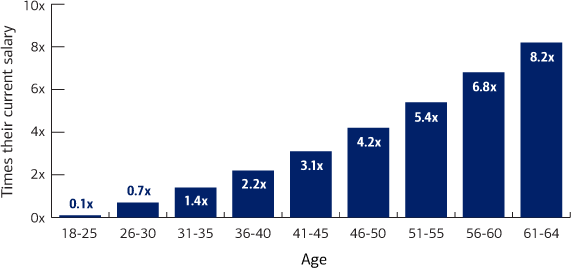
Source: Banking company of America, "Financial Wellness: 2020 Retirement savings guidance," 2020. Annotation: Calculations are based on obtaining 38% of income replacement from retirement savings (pre-taxation) for middle income households of $40,000 to $100,000 annually.
For example, if 35-twelvemonth-one-time Jane, who earns $seventy,000 a year, wants to run across how her savings mensurate upwardly to the all-time savers in her age grouping, she would just multiply her current salary by i.4 and compare that with her current savings. Thus, to keep up with the "all-time savers and investors" in her peer salary grouping, she would need to accept saved $98,000 ($seventy,000 x 1.four) so far.Footnote 3
- To run into where you are and what you lot tin change to stay on rails for the time to come:
The Merrill Personal Retirement Calculator lets you view a projection of your savings to see if in that location is a gap between what y'all'll accept and what you'll need when yous finally retire and helps you conform your strategy accordingly.
With the estimator, you lot can see how potential adjustments to your savings goal, retirement date and investment choices can bear on the size of your retirement savings in the future.
Simply fifty-fifty if this checkpoint shows that you're behind where you might be, don't get discouraged by the big numbers you may come across, advises Storey.
A small change in savings could give you essentially more afterward 30 years.
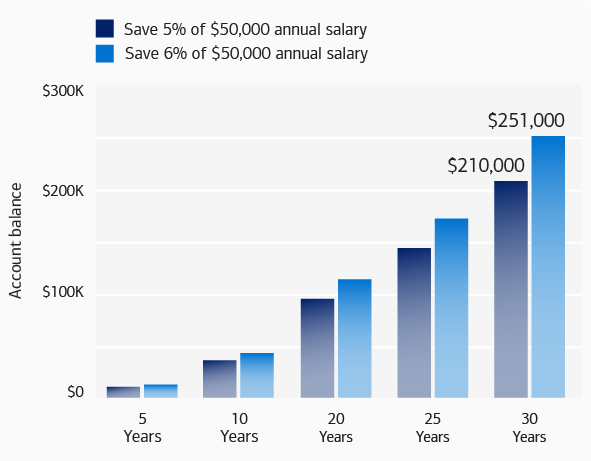
Source: Bank of America, April 2021. This example is hypothetical and does not stand for the performance of a particular investment. This example assumes annual returns net of fees and expenses. Your results volition vary. Actual investing includes fees and other expenses that may result in lower returns than this hypothetical example.
Whatever you save and invest today for the long term can make a large difference in the future. "If you need to save more, even a 1% increase tin can mean a lot over time," he says.
Footnote 1 Based on estimates from the Health and Retirement study (HRS) and the Consumption Activities and Mail Survey (CAMS) in EBRI notes.
Footnote 2 Note: Housing costs include mortgage or rent payments, property insurance, property taxes, utilities and maintenance. They typically become down in retirement considering mortgages are paid off, property taxes are less due to downsizing, and utility bills are lower with fewer people in the household.
Footnote three This number refers to fiscal avails minus personal (non-mortgage) debt. "Best savers and investors" refers to those whose Net Wealth to Income Ratio is in the tiptop quintile.
Investing involves risk. There is always the potential of losing money when you invest in securities.
This material should exist regarded every bit (general or educational) information on Social Security considerations and is not intended to provide specific Social Security communication. If you accept questions regarding your particular state of affairs, please contact your legal or tax advisor.
MAP4458859-03222023
Source: https://www.merrilledge.com/article/how-much-do-you-really-need-to-save-for-retirement
Posted by: walleyvarom1999.blogspot.com
0 Response to "How Much Money Should You Have At Retirment"
Post a Comment